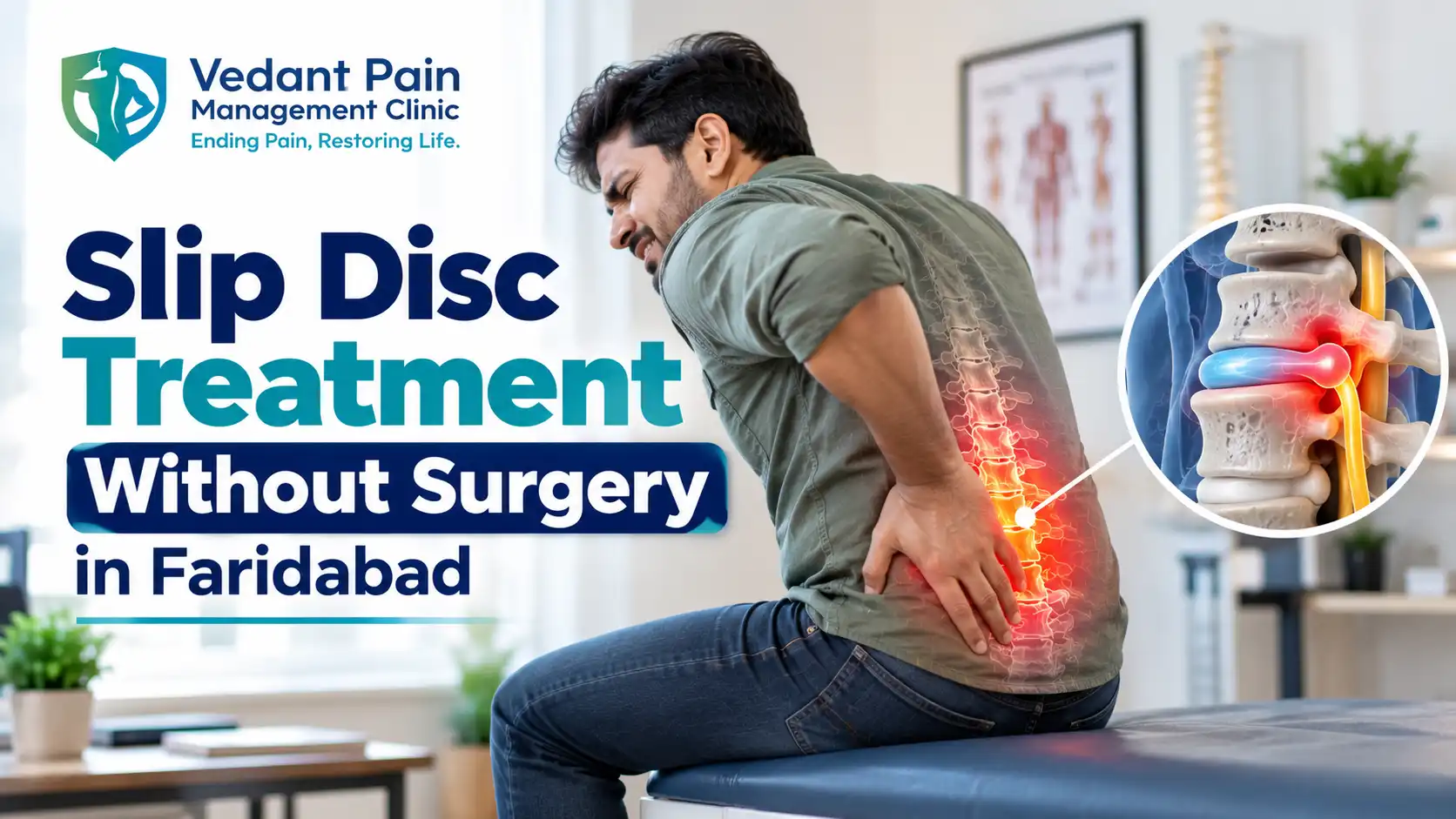
A scan that says disc bulge or slipped disc can be alarming, and the next sentence you hear is often about surgery. In reality, slip disc treatment without surgery works for a large number of people, and an operation is needed only in a smaller group with specific warning signs. At Vedant Pain Management Clinic in Faridabad, we match the treatment to your symptoms and your scan together, and we tell you honestly where you stand.
This page focuses on the non-surgical route: what it includes, how it differs for L4 L5 and L5 S1 problems, what recovery looks like, and the signs that mean surgery should be discussed. For a general overview of the condition, see our slip disc treatment page.
Can a Slip Disc Heal Without Surgery?
A spinal disc has a tough outer ring and a soft centre. When the ring weakens, the centre can push outward and press on or irritate a nerve. Much of the pain does not come from pressure alone but from the chemical inflammation around the nerve. That is encouraging, because inflammation can settle with time and the right treatment.
In many people the herniated part of a disc also shrinks gradually over weeks to months as the body clears it. This is one reason why a trial of non-surgical care is the standard first step unless there are danger signs. It does not mean the disc looks perfect on a repeat scan. It means the nerve calms down and function returns.
Slip Disc vs Disc Bulge
People use the two terms loosely. A bulge usually means the disc has extended beyond its normal edge, while a slip or herniation generally means part of the inner material has pushed through the outer ring. Both can cause back pain and leg symptoms, and the treatment principles are similar. If your report says disc bulge, you can read about our disc bulge treatment approach as well.
L4 L5 and L5 S1 Disc Bulge Treatment
The two lowest discs in the lumbar spine take the most load, so they are the ones that most often bulge. The level matters because it decides which nerve is affected and where you feel the symptoms.
- L4 L5 disc bulge. Often affects the L5 nerve, with pain or numbness along the outer leg and the top of the foot, and sometimes difficulty lifting the big toe or foot.
- L5 S1 disc bulge. Often affects the S1 nerve, with pain down the back of the thigh and calf, tingling in the sole or outer foot, and sometimes weakness when pushing off the toes.
The principles of L4 L5 disc bulge treatment and L5 S1 disc bulge treatment are the same: calm the nerve, restore movement and strengthen the muscles that protect the spine. Where they differ is the target. If an injection is needed, it is aimed at the exact nerve root involved, which is why we examine you carefully and match the findings to the MRI instead of treating the scan.
Non-Surgical Treatment Options for a Slip Disc
Activity guidance and short-term rest
For the first few days, avoid movements that clearly worsen the pain, such as heavy lifting, long sitting and deep forward bending. Do not stay in bed for long. Gentle walking and changing position often is better for recovery than complete rest.
Medicines
Pain and anti-inflammatory medicines, and sometimes nerve pain medicines, are used for a limited period so that you can move and sleep. We explain what each one is for and when to stop it.
Physiotherapy and core strengthening
Once the acute pain eases, a structured exercise plan builds the deep abdominal and back muscles that support the spine. Posture correction and hip mobility work reduce the strain that repeated bending puts on the discs. This phase is what lowers the chance of the problem coming back.
Epidural steroid injections
If leg pain remains severe despite medicines, an image-guided epidural injection can deliver anti-inflammatory medicine near the affected nerve. The caudal epidural is one route, and a targeted nerve root approach is another. The injection does not push the disc back into place. It reduces inflammation so that you can exercise and heal.
Selective nerve root block
When one nerve root is clearly responsible, a selective nerve root block treats that nerve and also helps confirm the source of pain.
Cooled radiofrequency for disc-related pain
For selected people whose pain is coming from the disc itself and is long-standing, bipolar intradiscal cooled RFA may be discussed after diagnosis. It is not a first-line option and is not suitable for everyone.
Is There a Slip Disc Cure?
People often search for a slip disc cure, and it helps to be realistic. No exercise, machine or injection can promise to restore a disc to its original state. What good care can do is remove the pain, return you to work and sport, and lower the risk of repeat episodes. Be careful of clinics that promise a permanent cure in a few sessions, or that recommend a procedure before examining you.
What Recovery Usually Looks Like
- First two weeks. Pain control, activity changes and gentle movement. Leg pain is often the first symptom to ease.
- Weeks two to six. Physiotherapy begins in earnest, and an injection is considered if pain is limiting exercise.
- Weeks six to twelve. Strength and endurance work, a return to regular activity and review of progress.
- After that. A maintenance routine of walking, core exercises and sensible lifting habits.
This is a general pattern, not a promise. Some people move faster, and some need extra steps.
When Surgery Should Be Discussed
An operation is worth considering if there is progressive weakness in the leg or foot, loss of bladder or bowel control, numbness around the groin or inner thighs, or severe pain that has not improved after a proper trial of non-surgical care with a matching scan. The first three are emergencies, so please go to a hospital straight away if they occur. If surgery is the right answer for you, we will say so and refer you to a spine surgeon.
Common Myths About Slip Disc Treatment
- "A slip disc always needs surgery." Most do not. Surgery is reserved for specific situations, as described above.
- "Rest in bed until it heals." Prolonged bed rest weakens muscles and often slows recovery. Short rest followed by gentle movement works better.
- "The MRI shows exactly where the pain comes from." Scans show structure, not pain. Many people with a bulge on MRI have no symptoms, so the examination matters as much as the report.
- "An injection will push the disc back." Injections reduce inflammation around the nerve. They do not move the disc.
- "Once treated, it will never return." Recurrence is possible, which is why exercise and posture habits remain part of the plan.
Knowing which beliefs are true saves you from unnecessary fear and from treatments that do not match your problem.
Habits That Protect Your Discs
- Lift with bent knees and a straight back, and hold loads close to your body
- Avoid sitting for more than 30 to 40 minutes at a stretch
- Strengthen your core a few times a week, not only when you are in pain
- Keep your weight in a healthy range
- Stop smoking, since it is linked with faster disc degeneration
- Use a supportive chair and a firm, comfortable mattress
Slip Disc Treatment in Delhi, Noida and Faridabad
Our clinic is in Sector 9, Faridabad, and patients regularly come from Delhi, Noida and Gurugram. If you are looking for slip disc treatment in Delhi, a single consultation with your MRI is the most efficient way to learn whether you need non-surgical care, a procedure or a surgical opinion. If the main complaint is leg pain, you may also find our page on sciatica treatment useful.
Address: House No. 21, Sector 9, Opposite Sector 9 Huda Market, Faridabad, Haryana 121006
Phone: +91 8171244512
Visiting hours: 9 AM to 7 PM
Book a Slip Disc Consultation
Bring your MRI and any previous reports. Our pain specialist Dr. Rakhi Goyal will examine you, explain your options and give you a clear plan. You can also read about our wider spine specialist care in Delhi NCR.