


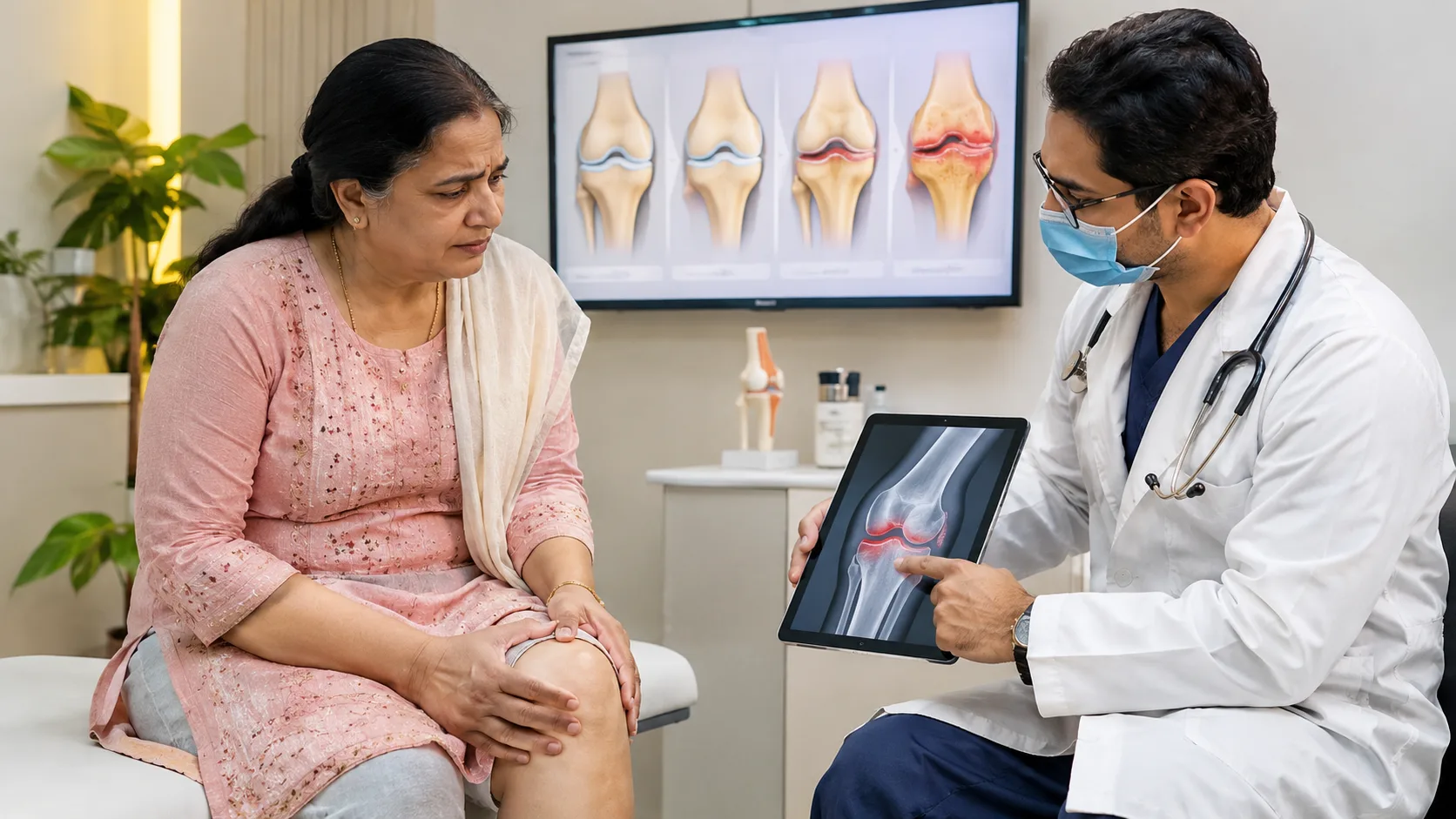
Knee Osteoarthritis Grades and Treatment
That sentence is often said too early. Knee osteoarthritis grades describe what the X-ray shows, not how much pain you feel or how much life you can still get out of your knee. This guide explains each grade from 1 to 4, what it means in daily life, and the knee osteoarthritis grades and treatment options that work at each stage. That includes knee replacement alternatives such as genicular nerve radiofrequency ablation for people who want to avoid or delay surgery.
What Is Knee Osteoarthritis?
Knee osteoarthritis (OA) is a gradual wearing down of the smooth cartilage that cushions the ends of the thigh bone (femur) and shin bone (tibia), and the back of the kneecap. As cartilage thins, the joint space narrows. The bone underneath reacts by hardening and growing bony edges called osteophytes or bone spurs. The joint lining becomes inflamed, and the muscles around the knee weaken.
It is not simply “wear and tear” from age. Several factors drive it:
- Age, usually after 45–50
- Female sex, especially after menopause
- Excess body weight, which multiplies the load on the knee with every step
- Previous knee injury, such as a ligament or meniscus tear
- Bow legs (genu varum), which overload the inner side of the knee and are very common in Indian patients
- Lifestyle habits such as frequent squatting, sitting cross-legged and repeated stair climbing
- Family history
- Weak thigh muscles, particularly the quadriceps
Knee Osteoarthritis Symptoms
Knee osteoarthritis symptoms usually build slowly over months or years:
- Pain on walking, climbing stairs, squatting or getting up from a chair
- Morning stiffness lasting less than 30 minutes
- Stiffness after sitting for a while (“gelling”)
- Grinding or crackling sounds (crepitus) when bending the knee
- Swelling, especially after a busy day
- Reduced ability to bend or straighten the knee fully
- A feeling of the knee “giving way”
- Visible deformity, such as bow legs, in later stages
Pain in early OA tends to come and go with activity. In later stages, it may appear at rest and at night.
How Knee Osteoarthritis Is Graded
Doctors most often use the Kellgren–Lawrence (KL) grading system, based on a standing X-ray of the knee. It looks at three things: joint space narrowing, bone spurs and changes in the bone under the cartilage.
| Grade | Severity | What the X-ray shows |
|---|---|---|
| Grade 0 | Normal | No signs of osteoarthritis |
| Grade 1 | Doubtful | Possible tiny bone spurs; joint space normal |
| Grade 2 | Mild | Definite bone spurs; possible joint space narrowing |
| Grade 3 | Moderate | Multiple bone spurs; definite joint space narrowing; some bone hardening |
| Grade 4 | Severe | Large bone spurs; marked narrowing or “bone-on-bone”; severe hardening and deformity |
One important point: X-ray grade and pain do not always match. Some people with grade 4 knees walk comfortably, while some with grade 2 are in severe pain. Treatment decisions should be based on your symptoms, function and goals, not the X-ray alone.
Grade 1 Knee Osteoarthritis: Doubtful
What it means
Very early changes, often found by chance on an X-ray done for another reason. Most people have little or no pain.
Treatment for grade 1
- Weight management if you’re overweight
- Regular low-impact exercise: walking on flat ground, cycling, swimming
- Quadriceps and hip strengthening exercises
- Avoiding prolonged squatting and sitting cross-legged on the floor
- Supportive, cushioned footwear
This is the stage where prevention works best. Small changes now can delay progression by years.
Grade 2 Knee Osteoarthritis: Mild
What it means
Definite but mild changes. Pain usually appears with longer walks, stairs or squatting, and settles with rest. Morning stiffness may be present.
Treatment for grade 2
- A structured physiotherapy and strengthening programme
- Weight loss: losing even 5–10% of body weight can noticeably reduce knee pain
- Short courses of painkillers or topical anti-inflammatory gels for flare-ups
- Knee supports or braces for long walks
- Platelet-rich plasma (PRP) injections for selected patients, to reduce pain and support joint health
- Hyaluronic acid (viscosupplementation) injections in some cases
Many grade 2 patients stay comfortable for years with these measures alone.
Grade 3 Knee Osteoarthritis: Moderate
What it means
Grade 3 is where most patients first consult a specialist. The joint space is clearly narrowed, bone spurs are visible, and pain is frequent. Walking distance shrinks, stairs become difficult, and the knee may swell after activity. Many patients are told at this point that a knee replacement is coming.
Grade 3 knee osteoarthritis treatment
Grade 3 knee osteoarthritis treatment aims to control pain, keep you active and delay surgery for as long as possible. At our clinic, the plan usually includes:
- Intensive physiotherapy focused on quadriceps, hamstring and hip strength
- Image-guided intra-articular injections: steroid injections for acute swollen flare-ups, PRP for longer-term pain relief, or hyaluronic acid in selected cases
- Genicular nerve block: a test injection that numbs the small nerves carrying pain from the knee, showing whether ablation is likely to help
- Genicular nerve radiofrequency ablation (RFA): if the test block works, RFA gives longer-lasting relief, often 6–12 months or more
- Unloader knee braces for bow-legged knees
- Weight loss and activity changes
With the right combination, many people with grade 3 knees walk, travel and manage stairs comfortably and either delay or avoid knee replacement.
Grade 4 Knee Osteoarthritis: Severe
What it means
Grade 4 knee osteoarthritis is often described as “bone-on-bone”. The cartilage is largely worn away, bone spurs are large, and the knee may be visibly bent or bowed. Pain can be constant, including at night, and walking even short distances is difficult.
Treatment for grade 4
Knee replacement is often the most definitive option for grade 4, but it is not right for everyone. Surgery may not be suitable, or may need to wait, for people who:
- Are older or have heart, lung or kidney disease that raises surgical risk
- Have uncontrolled diabetes or obesity
- Have had a replacement on one side and are not ready for the other
- Simply don’t want surgery
For these patients, genicular nerve RFA is one of the most useful knee replacement alternatives. It treats pain without changing the joint itself. Combined with physiotherapy, walking aids and weight management, it can restore meaningful mobility and sleep.
Knee Osteoarthritis Treatment Without Surgery
Across all grades, knee osteoarthritis treatment without surgery rests on a few core pillars:
1. Exercise and physiotherapy
Strong thigh and hip muscles act as natural shock absorbers. Every major guideline recommends exercise as the foundation of knee OA care.
2. Weight management
Each extra kilogram of body weight adds several kilograms of force through the knee when you walk or climb stairs. Weight loss is one of the most effective treatments for knee pain.
3. Medicines
- Paracetamol or topical NSAID gels for mild pain
- Oral NSAIDs for short periods, with caution in people with stomach, kidney or heart problems
- Duloxetine for long-standing pain in selected patients
Long-term daily painkillers carry real risks, especially in older adults. Interventional treatments can often reduce the need for them.
4. Injections
- Corticosteroid injections give quick relief in swollen, inflamed knees, but are best limited to a few times a year
- PRP injections use your own blood platelets to reduce pain and inflammation, and work best in grades 1–3
- Hyaluronic acid lubricates the joint and helps some patients
5. Interventional pain procedures
Genicular nerve blocks and radiofrequency ablation target the nerves that carry pain from the knee, particularly in grades 3 and 4.
6. Supports and aids
Unloader braces, knee sleeves, cushioned footwear, a walking stick in the opposite hand, and a Western-style toilet or raised seat all reduce strain on the knee.
Knee Replacement Alternatives: What Works for Advanced Arthritis
For people with moderate to severe arthritis who want to avoid or delay surgery, these are the main knee replacement alternatives we offer.
Genicular nerve radiofrequency ablation (RFA)
The knee’s pain signals travel along small nerves called genicular nerves. In genicular nerve RFA, the doctor places thin needles next to these nerves under ultrasound or X-ray guidance and uses controlled heat to stop them carrying pain signals. The nerves carry sensation only, so the muscles and stability of the knee are unaffected.
Key points:
- Day-care procedure under local anaesthesia, typically taking 45–60 minutes
- Walking the same day
- Relief usually builds over 2–4 weeks
- Studies, including several from India, show significant pain relief and better function for around a year in many patients with grade 3 and 4 OA
- Can be repeated when the nerves regrow
Learn more about who is suitable and what to expect on our Genicular Nerve RFA page.
Cooled radiofrequency and pulsed radiofrequency
Cooled RFA creates larger treatment zones and may offer longer relief in some patients. Pulsed RFA is a gentler option that does not destroy nerve tissue.
Regenerative injections
PRP and, in selected cases, other regenerative options can reduce pain in early and moderate OA. They are less effective in bone-on-bone knees.
Combining treatments
In practice, the best results come from combinations. One example is genicular RFA for pain, followed by physiotherapy to rebuild muscle strength that pain had been holding back.
A typical patient journey
A 68-year-old retired government employee came to us with grade 3 osteoarthritis in both knees. She had been told she needed bilateral knee replacements, but she also had heart disease and was anxious about surgery. She could walk only 10 minutes before stopping. After a successful diagnostic genicular nerve block, we performed genicular nerve RFA on both knees two weeks apart and started her on a home strengthening programme. By her three-month review, she was walking about 40 minutes daily and had stopped her daily painkillers. Results vary from person to person, but this is the kind of outcome that makes RFA worth considering before surgery.
Exercises for Knee Osteoarthritis
Do these daily, slowly and within comfort. Mild muscle soreness is normal at first. Sharp joint pain is not.
1. Static quadriceps (knee press)
Sit with your leg straight. Press the back of your knee down into a rolled towel, tightening the thigh muscle. Hold for 10 seconds. Repeat 10–15 times.
2. Straight leg raise
Lie on your back with one knee bent. Keep the other leg straight, tighten the thigh and lift it about 30 cm. Hold for 5 seconds and lower slowly. Do 10 repetitions on each side.
3. Short arc knee extension
Lie with a rolled towel under your knee. Straighten the knee to lift your heel, hold for 5 seconds, and lower. Repeat 10–15 times.
4. Seated knee extension
Sit on a chair and straighten one knee fully. Hold for 5 seconds and lower. Add a light ankle weight as you get stronger. Do 10–15 repetitions on each side.
5. Side-lying leg raise
Lie on your side and lift the top leg about 30 cm, keeping it straight. This strengthens the hip muscles that stabilise the knee. Do 10 repetitions on each side.
6. Heel slides
Lie on your back and slowly slide your heel towards your buttock, bending the knee as far as comfortable, then straighten. Repeat 10 times to maintain flexibility.
7. Calf raises
Holding a chair for support, rise onto your toes and lower slowly. Repeat 10–15 times.
Avoid deep squats, sitting cross-legged, kneeling, jumping and running on hard surfaces. Walking, cycling on a stationary bike and water exercises are excellent low-impact options.
When Knee Replacement Is the Right Choice
We are not against surgery. Total knee replacement is an excellent operation for the right patient. It is worth discussing seriously when:
- Pain is severe and constant despite all appropriate non-surgical treatment
- Walking is limited to very short distances
- Pain disturbs sleep most nights
- The knee is badly deformed or unstable
- You are medically fit and ready for the recovery and rehabilitation involved
If surgery is the best option, we refer you to a trusted orthopaedic surgeon and help with pain management before and after the operation.
Knee Pain Treatment in Faridabad
At Vedant Pain Management Clinic in Sector 9, Faridabad, we treat knee osteoarthritis at every grade, from early strengthening programmes to PRP injections, genicular nerve blocks and genicular nerve radiofrequency ablation. Our patients come from Faridabad, Ballabhgarh, Palwal, South Delhi, Gurugram and Noida, many of them hoping to avoid or delay a knee replacement.
If knee pain is shrinking your world to a few rooms of the house, learn more about our Knee Pain Treatment in Faridabad, or ask us whether Genicular Nerve RFA is right for your knees.
Need Expert Consultation?
Told you need a knee replacement? Explore your options first.
Our pain specialists offer non-surgical treatment for every grade of knee osteoarthritis.
Call: +91 8171244512
House No. 21, Sector 9, Opp. Sector 9 HUDA Market, Faridabad, Haryana 121006
Mon–Sat: 9 AM – 7 PM