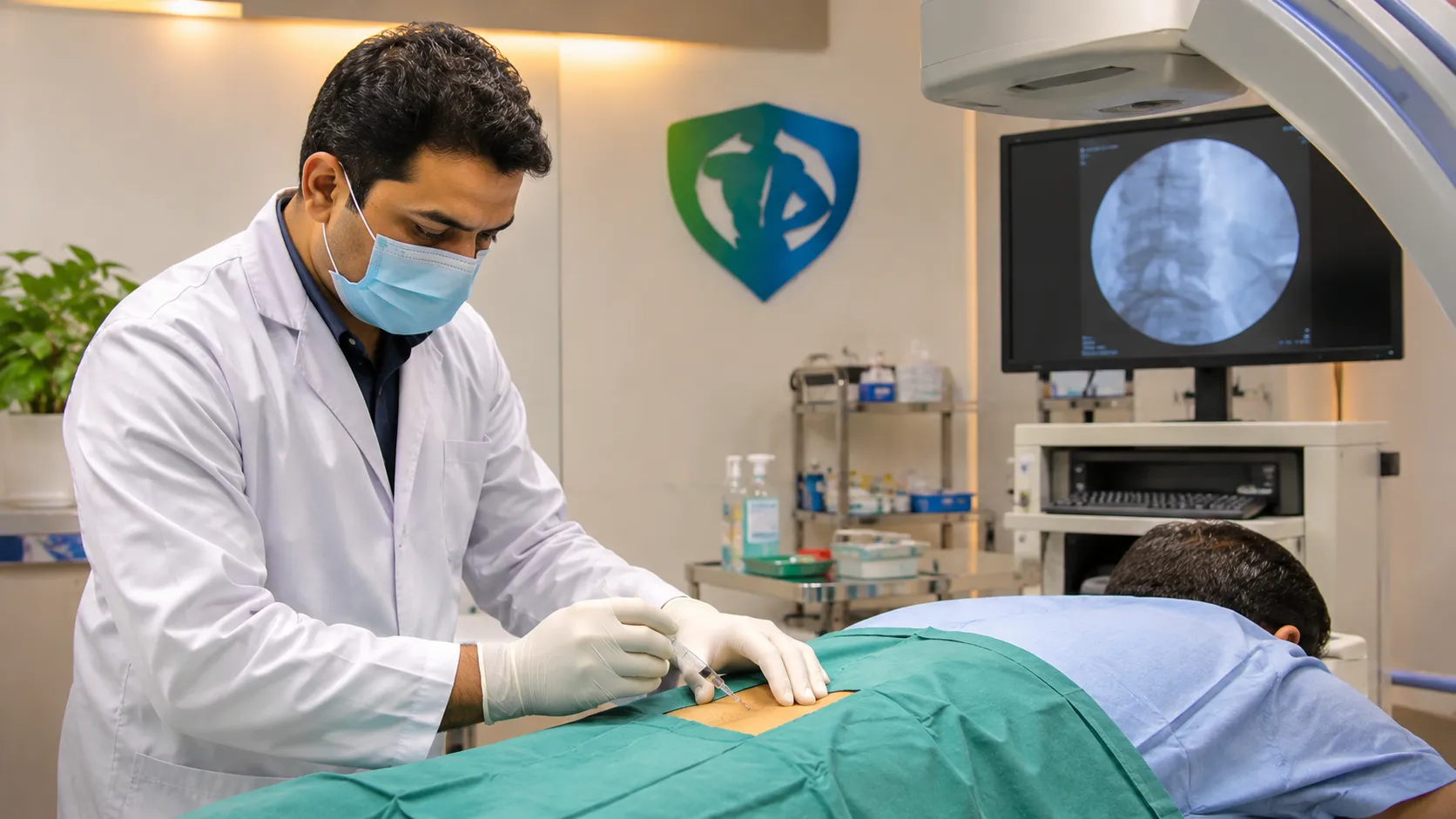
At Vedant Pain Management Clinic in Sector 9, we perform nerve block injections in Faridabad as short day-care procedures. Most patients walk out within a couple of hours. For many, a well-chosen nerve block brings relief that months of tablets could not. It also tells the doctor exactly which structure is causing the pain, which matters if longer-lasting treatment is needed later.
This page explains what a nerve block is, the types we offer (including the selective nerve root block, facet joint injection and medial branch block), who benefits, what happens on the day, results and risks, and how to prepare.
What Is a Nerve Block?
A nerve block is an injection of medicine around a specific nerve or group of nerves to stop it from sending pain signals. The medicine is usually a local anaesthetic, sometimes combined with a small dose of steroid to calm inflammation.
Nerve blocks serve two purposes.
Diagnostic nerve blocks
When it is unclear which structure is causing pain, the doctor numbs one suspected nerve or joint at a time. If the pain drops significantly within minutes, that nerve is confirmed as the source. This takes the guesswork out of planning further treatment, such as radiofrequency ablation.
Therapeutic nerve blocks
Here the goal is relief. The anaesthetic gives immediate numbness. The steroid, when used, reduces swelling and irritation around the nerve over the following days. This often breaks the pain cycle, so physiotherapy and normal movement become possible again.
Why Image Guidance Matters
A nerve block is only as good as its accuracy. The nerve roots, facet joints and medial branch nerves of the spine sit deep and close to important structures. A "blind" injection based only on surface landmarks can easily miss the target.
At our clinic, every nerve block injection is done under imaging:
- Fluoroscopy (live X-ray) for spinal procedures, with contrast dye to confirm that the medicine is spreading exactly where it should
- Ultrasound for shoulder, buttock, limb and peripheral nerve blocks, allowing the doctor to see the nerve, the needle and nearby blood vessels in real time
Image guidance improves results, reduces the amount of medicine needed and lowers the risk of complications.
Types of Nerve Block Injection We Offer in Faridabad
The right nerve block depends on where the pain starts. These are the procedures we perform most often.
Selective nerve root block (SNRB)
A Selective Nerve Root Block targets one spinal nerve root as it exits the spine. It is used for radiating pain, such as sciatica down the leg from a slip disc or disc bulge, or arm pain from cervical radiculopathy. The selective nerve root block can both confirm which nerve level is involved and reduce inflammation around a compressed root. It is particularly useful when the MRI shows changes at more than one level and the surgeon or pain doctor needs to know which one matters.
Facet joint injection
Facet joints are small paired joints at the back of each spinal segment. With age, posture strain or injury, they can become arthritic and painful. Facet pain is typically felt in the back or neck, gets worse when bending backward or twisting, and is often stiff in the morning. A facet joint injection places medicine directly into the joint under fluoroscopy. We perform lumbar facet blocks, cervical facet blocks and thoracic facet blocks.
Medial branch block
Each facet joint is supplied by two small nerves called medial branches. A Medial Branch Block numbs these nerves. If your pain improves clearly after the block, usually on two separate occasions, you are likely to be a good candidate for radiofrequency ablation of the same nerves, which can provide relief for many months. The medial branch block is the standard way to confirm facet joint syndrome before RFA.
Suprascapular nerve block
The suprascapular nerve supplies a large part of the shoulder joint. An ultrasound-guided Suprascapular Nerve Block is very effective for frozen shoulder, rotator cuff pain and shoulder arthritis. It reduces pain enough to allow stretching and physiotherapy, which is where real recovery happens.
Epidural injections
Epidural steroid injections spread medicine across the epidural space around several nerve roots. We offer caudal epidural injections for low back and leg pain, especially in lumbar canal stenosis, and cervical epidural injections for neck and arm pain. For scar tissue after spine surgery, transforaminal epidural adhesiolysis may be advised.
Other targeted blocks
- Ganglion impar block for tailbone (coccyx) and pelvic pain
- Piriformis injection for deep buttock pain and piriformis syndrome
- Sympathetic blocks for complex regional pain syndrome, vascular pain and certain cancer pain
- Sacroiliac joint injection for pain at the lower back and buttock
- Occipital nerve blocks for occipital neuralgia and cervicogenic headache
- Trigger point injection for painful muscle knots
Conditions That Respond to a Nerve Block
A nerve block injection may help if you have:
- Sciatica, slip disc or disc bulge with leg pain
- Cervical radiculopathy with arm pain, tingling or numbness
- Lumbar spondylosis and lumbar canal stenosis
- Facet joint arthritis in the neck or lower back
- Failed back surgery syndrome
- Frozen shoulder and rotator cuff pain
- Post-herpetic neuralgia after shingles
- Coccydynia, piriformis syndrome and buttock pain
- Complex regional pain syndrome
- Cancer pain that is difficult to control with medicines
Who Is a Good Candidate?
You may benefit from a nerve block if:
- Pain has lasted more than six weeks despite medicines, rest and physiotherapy
- Pain is severe enough to affect sleep, work or walking
- The pain follows a clear nerve pattern, for example down one leg or one arm
- Your doctor needs to confirm the exact pain source before planning RFA or surgery
- You want to avoid or delay surgery, or you are not fit for an operation
A nerve block may not be suitable, or may need extra planning, if you have an active infection, uncontrolled diabetes, a bleeding disorder, are taking blood thinners that cannot be paused safely, are pregnant, or have an allergy to contrast dye or local anaesthetic. Your doctor will check all of this at the consultation.
Seek urgent care instead if back pain comes with loss of bladder or bowel control, numbness in the groin area, or rapidly worsening leg weakness. These can be signs of serious nerve compression that needs emergency assessment.
What Happens During a Nerve Block Injection
Before the procedure
- Consultation: the doctor reviews your symptoms, examination and MRI or X-ray to choose the right block and level.
- Tests: blood sugar, and sometimes clotting tests, especially if you have diabetes or take blood-thinning medicine.
- Medicines: you will be told which medicines to continue and whether blood thinners need to be paused, in consultation with your prescribing doctor.
- Food: light food is usually fine. If sedation is planned, you will be asked not to eat for a few hours before.
- Company: bring a family member to drive you home.
On the day
- You lie on the procedure table, usually on your stomach for spine injections or your back or side for others.
- The skin is cleaned with antiseptic and numbed with local anaesthetic.
- Under fluoroscopy or ultrasound, the doctor guides a thin needle to the target.
- For spinal blocks, a small amount of contrast dye confirms the correct spread.
- The medicine is injected slowly.
- The procedure usually takes 15 to 30 minutes.
Most patients feel pressure and brief discomfort rather than sharp pain. Light sedation is available for anxious patients.
After the procedure
You rest in the observation area for 30 to 60 minutes. The doctor may ask you to move and rate your pain, especially after a diagnostic block. Then you go home the same day.
Recovery and Results
- First few hours: the area may feel numb or heavy as the anaesthetic works. This is temporary.
- Day 1 to 3: some soreness at the injection site is normal. Pain may briefly return as the anaesthetic wears off, before the steroid starts working.
- Day 3 to 7: steroid relief usually builds during this period.
- Return to routine: most people go back to light work the next day. Avoid strenuous activity for 24 to 48 hours.
How long relief lasts varies. Some patients get relief for several weeks, others for several months. Combined with the right exercises and posture changes, many need no further injection. When a block works well but relief fades, longer-lasting options such as radiofrequency ablation may be planned.
Our pain rehabilitation programme and guided exercises help make the most of the pain-free window a nerve block creates.
Risks and Safety
Nerve blocks are among the safest interventional pain procedures, especially when they are image-guided. Possible side effects include:
- Temporary numbness or weakness in the area supplied by the nerve
- Soreness or bruising at the injection site
- A short-lived rise in blood sugar in people with diabetes
- Facial flushing or disturbed sleep for a day or two after steroids
- Rarely, infection, bleeding, headache or nerve irritation
We reduce these risks with strict sterile technique, image guidance, careful patient selection and the lowest effective steroid dose. Steroid injections are spaced out and not repeated without good reason.
Nerve Block Injection Cost in Faridabad
The cost depends on the type of block, the number of levels treated, whether fluoroscopy or ultrasound is used and whether sedation is needed. You will receive a clear estimate before the procedure. Many nerve block procedures can be covered under health insurance, and our team can help with the paperwork through our Insurance Assistance service.
More Pain Treatments at Our Clinic
Nerve blocks are one part of a complete pain management service. We also offer:
- Radiofrequency ablation: sacroiliac joint cooled RFA, hip cooled RFA, trigeminal ganglion RFA, bipolar intradiscal cooled RFA and knee genicular cooled RFA
- Ultrasound-guided nerve release: USG-guided hydrodissection of the median, ulnar, radial and tibial nerves
- Regenerative treatment: PRP injection and regenerative medicine
- Spine procedures: vertebroplasty, kyphoplasty and provocative discography
- Neuromodulation: spinal cord stimulator and intrathecal pump
- Muscle and soft tissue care: dry needling, bursa injection and tendon injection
Meet Our Pain Specialists
Dr. Mohit Gupta, Interventional Pain Physician
Dr. Mohit Gupta holds an MBBS, an MD in Anaesthesiology and a fellowship in pain medicine. He has more than 10 years of experience and has treated over 5,000 patients, with a focus on fluoroscopy-guided spine procedures, nerve blocks and radiofrequency ablation.
Dr. Rakhi Goyal, Senior Consultant
Dr. Rakhi Goyal completed her MBBS at PDUMC, followed by an MD in Anaesthesiology and a fellowship in pain medicine. She manages chronic spine, joint and nerve pain with conservative and minimally invasive care.
Why Choose Vedant Pain Management Clinic for a Nerve Block in Faridabad
- Every block done under fluoroscopy or ultrasound guidance
- Diagnosis first, so the injection is chosen for your specific pain source
- Day-care procedures with no hospital stay
- Clear advice on when a nerve block will help and when it won't
- A full treatment pathway beyond the injection, from RFA to rehabilitation
- Rated 4.9 out of 5 from more than 360 Google reviews
Our clinic is in Sector 9, opposite the Sector 9 HUDA Market. Patients come to us from across Faridabad, including NIT, Old Faridabad, Ballabgarh, Greater Faridabad and Neharpar, as well as from Palwal and South Delhi.
Book a Nerve Block Consultation in Faridabad
A nerve block injection can relieve pain and also show exactly where it comes from. Talk to our pain specialists about whether it is right for you.
Call +91 8171244512 or Book Your Consultation
Vedant Pain Management Clinic, House No. 21, Sector 9, Opp. Sector 9 HUDA Market, Faridabad, Haryana 121006 | Open 9 AM to 7 PM
Medically reviewed by Dr. Mohit Gupta, MBBS, MD (Anaesthesiology), Fellowship in Pain Medicine