


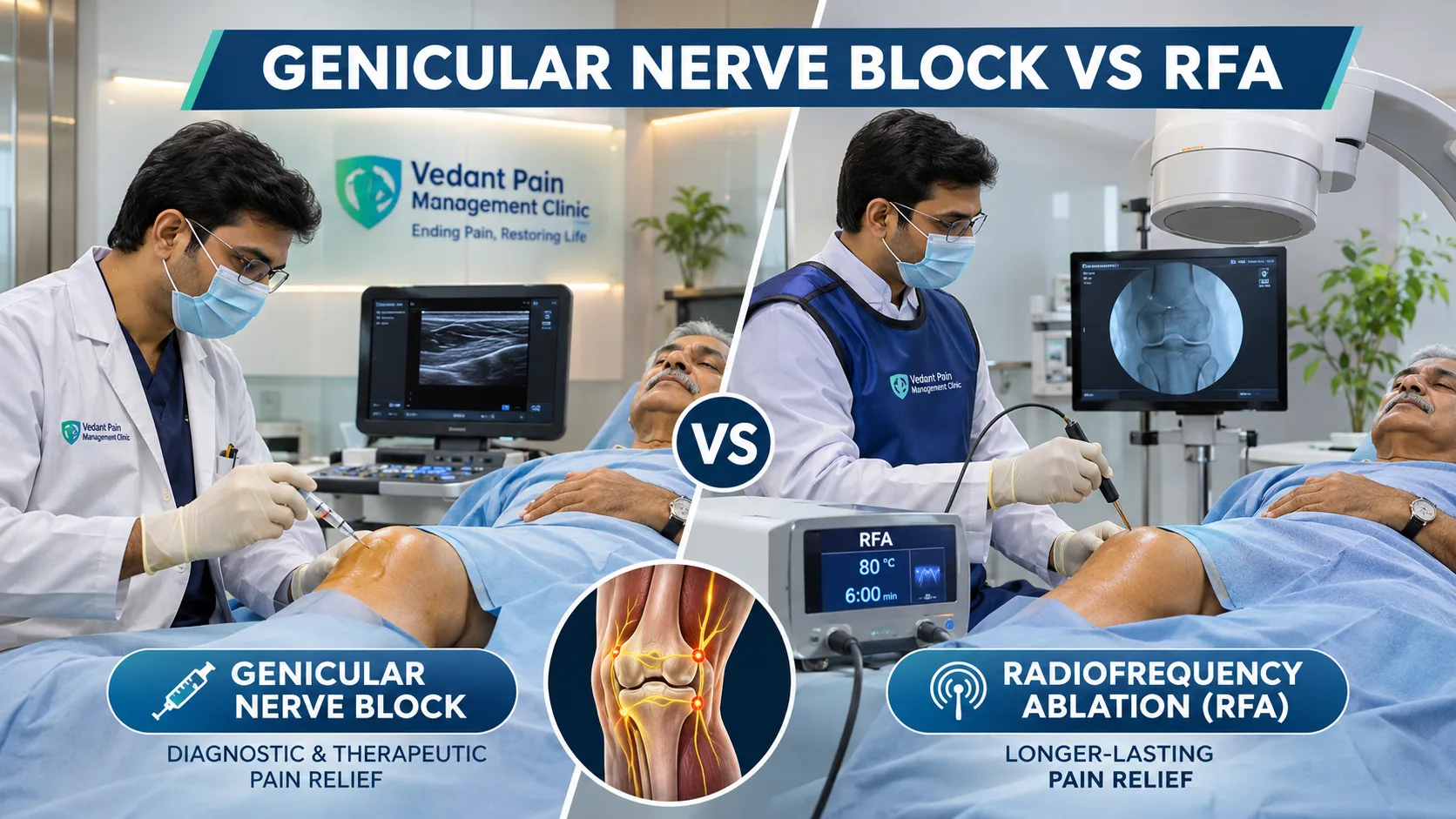
Genicular Nerve Block vs RFA: Which Knee Pain Treatment Is Right for You?
If knee arthritis has started deciding how far you can walk, whether you can sit cross-legged, or how you climb the stairs at home, you have probably heard two names from a pain specialist: the genicular nerve block and genicular nerve radiofrequency ablation (RFA). Both target the same small nerves around the knee. Both are done without cutting open the joint. Yet they do very different jobs, last for very different lengths of time, and suit different patients.
This guide compares genicular nerve block vs RFA side by side: how each works, how long relief lasts, recovery, risks, cost factors in India, and who is a good candidate for each. It is written from what we see every week at Vedant Pain Management Clinic in Faridabad, where knee pain from osteoarthritis is one of the most common reasons patients come to us after being told that knee replacement is "the only option".
What Are the Genicular Nerves and Why Do They Matter?
The genicular nerves are small sensory branches that wrap around the knee joint and carry pain signals from the joint capsule, ligaments and bone ends to the brain. They do not control the muscles that move your leg. This is the key reason doctors can safely target them: quietening these nerves reduces pain without weakening the knee.
Most procedures target three main branches:
- Superomedial genicular nerve (upper inner side of the knee)
- Superolateral genicular nerve (upper outer side)
- Inferomedial genicular nerve (lower inner side)
Newer protocols often add more branches, because research shows the knee has a richer nerve supply than the classic three-nerve map suggests. At our clinic we decide the targets after examining where your pain sits and reviewing your X-ray or MRI.
When arthritis wears down cartilage, these nerves fire constantly. Pain then limits movement, the thigh muscles weaken, and the knee becomes stiffer and more painful. Interrupting that pain signal gives you a window to break the cycle with exercise and physiotherapy. You can read more about how arthritis progresses in our guide to knee osteoarthritis grades and treatment.
What Is a Genicular Nerve Block?
A genicular nerve block is an injection of local anaesthetic, sometimes combined with a small dose of steroid, placed right next to the genicular nerves. The medicine temporarily switches off the nerve's ability to send pain signals.
How the procedure is done
You lie on your back with a small cushion under the knee. The skin is cleaned and numbed. Using ultrasound or fluoroscopy (live X-ray) guidance, the doctor places a thin needle beside each target nerve and injects a few millilitres of medicine. The whole procedure usually takes 15 to 20 minutes, and you walk out the same day.
How long does a genicular nerve block last?
The local anaesthetic alone wears off within hours. When a steroid is added, many patients feel relief for a few weeks, and some for two to three months. The duration varies a lot from person to person and depends on the stage of arthritis, body weight and activity levels.
The two roles of a nerve block
A genicular nerve block serves two purposes:
- Diagnostic test: If your pain drops substantially (usually by 50% or more) in the hours after the block, it confirms that the genicular nerves are carrying most of your knee pain. That makes you a strong candidate for RFA.
- Short-term treatment: For patients who are not ready for RFA, have mild disease, or need relief before an event or a course of physiotherapy, a block can be the treatment itself.
What Is Genicular Nerve RFA?
Genicular nerve radiofrequency ablation uses controlled heat to create a small lesion on the same nerves that were tested with the block. Instead of numbing the nerve for hours or weeks, RFA interrupts its pain signal for many months.
How RFA is done
The setup is similar to a nerve block. Under image guidance, the doctor places special RF needles beside each genicular nerve. Before treating, a test stimulation confirms that the needle sits next to a sensory nerve and away from any motor nerve. The area is then numbed and the needle tip is heated, typically to around 80°C for 60 to 90 seconds per nerve in conventional RFA. The procedure takes about 30 to 60 minutes and is done as a day-care procedure.
Conventional, pulsed and cooled RFA
There are three main variations:
- Conventional (thermal) RFA heats the nerve to create a lesion.
- Pulsed RFA delivers short bursts of energy at lower temperatures. It changes how the nerve transmits pain rather than destroying it, so relief tends to be shorter.
- Cooled RFA circulates water through the probe tip. This lets the doctor create a larger lesion without overheating nearby tissue, which improves the chance of catching nerves whose position varies from person to person.
At Vedant, we offer Genicular Nerve RFA, including cooled RFA for knee pain, and we choose the technique based on your anatomy and earlier response to the block.
How long does genicular RFA last?
Most patients who respond well report meaningful relief for around 6 to 12 months, and some for longer. Nerves slowly regrow, so pain can return. When it does, the procedure can usually be repeated if the first round helped.
Genicular Nerve Block vs RFA: Side-by-Side Comparison
Here is how the two procedures compare on the points patients ask about most:
| Factor | Genicular nerve block | Genicular nerve RFA |
|---|---|---|
| What it does | Temporarily numbs the genicular nerves with medicine | Interrupts the nerves' pain signal with controlled heat |
| Main purpose | Diagnostic test and short-term relief | Longer-term pain relief |
| Typical duration of relief | Hours (anaesthetic) to a few weeks or months (with steroid) | Around 6 to 12 months, sometimes longer |
| Procedure time | 15 to 20 minutes | 30 to 60 minutes |
| Guidance | Ultrasound or fluoroscopy | Fluoroscopy and/or ultrasound with nerve stimulation testing |
| Recovery | Normal activity the same or next day | Light activity next day; mild soreness for 1 to 2 weeks |
| Repeatable? | Yes, but steroid doses are limited | Yes, when pain returns, if the first round worked |
| Relative cost | Lower per session | Higher per session, lower cost per month of relief |
| Hospital stay | None (OPD/day care) | None (day care) |
The simplest way to remember the difference: the block is the test and the short-term fix; RFA is the longer-lasting treatment. In most cases they are not competitors. They are two steps of the same plan.
Which Is Better for You: Nerve Block or RFA?
The right choice depends on your stage of arthritis, how much the pain limits you, other health conditions, and your goals. Here is how we usually think about it.
A genicular nerve block alone may suit you if
- You have early to moderate arthritis and flare-ups come and go.
- You need short-term relief to start or continue physiotherapy.
- You are waiting for a planned knee replacement and need to stay mobile until then.
- You want to try a lower-cost option before committing to RFA.
Genicular RFA may suit you if
- You have had knee pain for more than three months despite medicines, exercises and injections.
- Your diagnostic block gave clear, strong relief.
- You have moderate to severe osteoarthritis but want to avoid or delay surgery.
- Surgery is risky for you because of age, heart disease, uncontrolled diabetes or other conditions.
- You still have pain after a knee replacement, once infection and loosening are ruled out.
When neither may be the right first step
If your pain comes mainly from a meniscus tear, a ligament injury, an inflammatory condition such as rheumatoid arthritis, or pain referred from the back or hip, a different treatment may work better. That is why a proper examination matters before any procedure. Our page on meniscus pain explains how that problem differs from arthritic pain.
What the Research Says
Being honest about the evidence helps patients set the right expectations.
- Genicular nerve blocks are well established as a way to confirm the source of knee pain before RFA, and several trials show useful short-term relief.
- Many clinical studies report that genicular RFA reduces pain and improves function for several months in patients who responded to a diagnostic block.
- Recent meta-analyses, including a 2025 review in Osteoarthritis and Cartilage, note that the quality of evidence is still mixed and that benefits vary between patients. Results depend heavily on patient selection, the number of nerves targeted and the technique used.
In practice, this means RFA works best when it is offered to the right patient, after a positive diagnostic block, by a team that maps the nerves carefully, and as part of a plan that includes strengthening exercises and weight management. It is a tool to reduce pain and restore movement, not a cure for arthritis.
Recovery After a Genicular Nerve Block and RFA
After a nerve block
- You can walk out of the clinic soon after the procedure.
- The knee may feel numb or slightly weak for a few hours, so arrange for someone to drive you home.
- Keep a pain diary for the first 6 to 8 hours if the block is diagnostic. Your doctor uses this record to decide on RFA.
- Most people return to normal routines the next day.
After RFA
- Expect some soreness, a burning feeling or numbness over the skin of the knee for 1 to 2 weeks. This is common and settles.
- Pain relief often builds gradually over 2 to 4 weeks rather than appearing overnight.
- Ice packs and simple painkillers help in the first few days.
- Start a guided exercise programme once the soreness eases. Strengthening the quadriceps while pain is low is what turns temporary relief into lasting improvement. Our pain rehabilitation team plans this with you.
Risks and Side Effects
Both procedures are considered low risk when done under image guidance by a trained pain physician. Possible side effects include:
- Temporary pain, bruising or swelling at the needle sites
- Temporary numbness or skin sensitivity around the knee
- A short rise in blood sugar for diabetic patients if steroid is used in the block
- Rarely, infection or bleeding
- Rarely after RFA, longer-lasting skin numbness or neuritis (nerve irritation)
Tell your doctor if you take blood thinners, have a pacemaker, a current infection, or are pregnant. These factors may change how or when the procedure is done.
Genicular Nerve Block and RFA Cost in India
In India, a genicular nerve block generally costs much less than RFA per session. RFA costs more because it uses specialised needles, an RF generator and longer procedure time. Cooled RFA usually costs more than conventional RFA because of its single-use probes.
Costs depend on:
- Whether one or both knees are treated
- The type of RFA (conventional, pulsed or cooled)
- The number of nerves targeted
- Imaging guidance and consumables
- Whether a diagnostic block is done first
Because RFA relief lasts many months, the cost per month of relief is often similar to or lower than repeated blocks or injections. For a detailed breakdown, read our guide on radiofrequency ablation cost in India. If you have health insurance, our insurance assistance team can help you check coverage.
How Nerve Block and RFA Fit Into Knee Pain Treatment Without Surgery
Neither procedure works best on its own. At Vedant Pain Management Clinic, we build a step-by-step plan that may combine:
- Diagnosis with a clinical examination, X-ray or MRI review, and a diagnostic genicular nerve block when needed
- Genicular nerve block or RFA to bring pain under control
- Regenerative options such as PRP injection for selected early and moderate arthritis. See our regenerative medicine page for details.
- Physiotherapy and exercise to strengthen the muscles that support the knee
- Weight and lifestyle guidance to reduce the load on the joint
This combined approach is what we mean by knee pain treatment without surgery for patients from Delhi NCR and Faridabad. For a broader look at your options, visit our knee osteoarthritis and chronic knee pain treatment page.
Other Pain Treatments at Vedant Pain Management Clinic
Knee pain often comes with problems elsewhere, such as the hip, back or shoulder. Under one roof, our team offers:
- Ultrasound-guided injections, including PRP, bursa, tendon and trigger point injections
- Nerve hydrodissection for trapped nerves such as carpal tunnel
- Fluoroscopy-guided spine procedures, including epidural injections, facet joint blocks and selective nerve root blocks
- Radiofrequency ablation for the knee, hip, sacroiliac joint, spine and trigeminal neuralgia, including hip cooled radiofrequency ablation
- Vertebroplasty and kyphoplasty for spinal fractures
- Spinal cord stimulation and intrathecal pump therapy for complex chronic pain
- Cancer pain and palliative care
- Pain rehabilitation, exercise programmes and diet guidance
You can explore all conditions we treat on our knee pain page and across the site.
Why Choose Vedant Pain Management Clinic in Faridabad
- Led by Dr. Mohit Gupta, an interventional pain physician with 10+ years of experience and 5,000+ patients treated
- Every genicular procedure done under ultrasound or fluoroscopy guidance
- Diagnostic block before RFA, so you only go ahead when the evidence supports it
- Day-care procedures with no hospital stay
- A complete plan that includes rehab, not just an injection
- Convenient location in Sector 9, Faridabad, easy to reach from South Delhi, Badarpur, Ballabgarh and Palwal
The Bottom Line
When it comes to genicular nerve block vs RFA, the question is rarely "which one is better" in general. A nerve block tells you whether the genicular nerves are driving your knee pain and can give short-term relief. RFA builds on a good block result to give many months of relief, so you can walk, exercise and sleep better, often without surgery.
If knee pain is holding you back, the most useful next step is an assessment that looks at your X-rays, your daily limits and your goals. From there, our team can tell you whether a block, RFA or another option is the right starting point.
Ready to find out if genicular nerve RFA is right for your knee? Call us at +91 81712 44512 or book a consultation with Dr. Mohit Gupta at Vedant Pain Management Clinic, Faridabad.