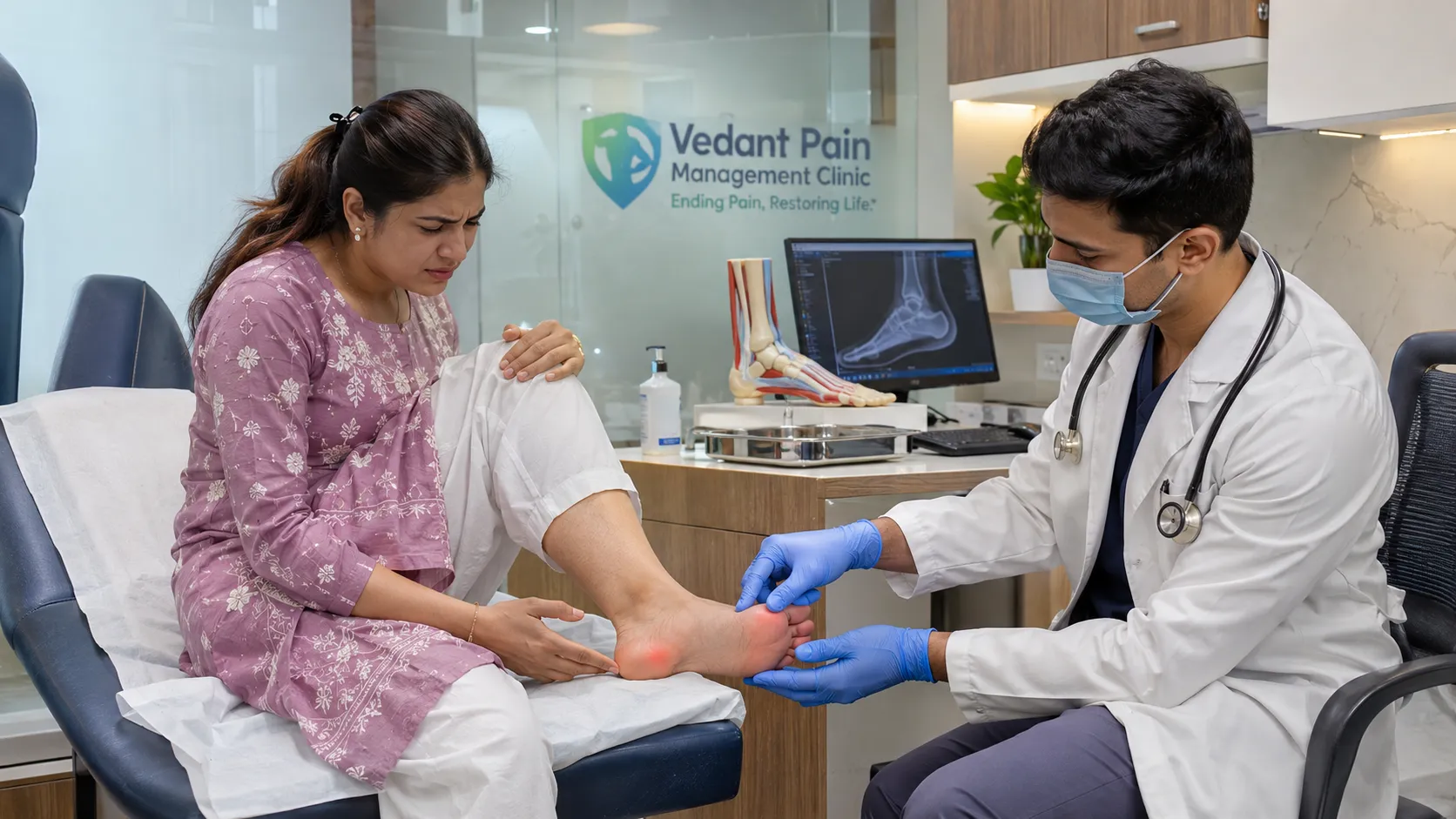
Most heel pain settles with the right conservative care. The problem is that many people spend months on painkillers, soft slippers and online stretches without knowing what is actually causing their pain. Some are told the "heel spur" on their X-ray must be removed. Others get repeated steroid injections that bring short relief and new risks.
At Vedant Pain Management Clinic in Sector 9, Faridabad, our pain physicians start by finding the exact source of your heel pain, often with ultrasound in the clinic. Then we build a treatment plan that moves step by step from simple measures to precise, image-guided procedures, only as far as you need.
This page explains what causes heel pain, how to treat heel pain at home, when to see a specialist, and every treatment option available at our clinic.
What Causes Heel Pain?
The heel bone (calcaneus) carries your full body weight with every step. Several different structures around it can become painful, and each needs a different treatment.
Plantar fasciitis
The plantar fascia is a thick band of tissue running from the heel to the toes. It supports the arch of your foot. Repeated strain causes small tears and thickening where it attaches to the heel. The result is pain under the heel that is worst with the first steps in the morning or after rest. For a detailed look at this condition and its stages, read our page on Plantar Fasciitis Treatment.
Achilles tendinopathy
Pain at the back of the heel, where the Achilles tendon attaches, points to Achilles tendinopathy or retrocalcaneal bursitis. It often comes with stiffness in the morning and pain when climbing stairs or walking uphill. Learn more on our Achilles Heel Pain page.
Heel spur
A heel spur is a bony outgrowth seen on X-ray at the front of the heel bone. Many people with heel spurs have no pain at all. Many people with severe heel pain have no spur. In most cases the spur is a sign of long-standing strain on the fascia, not the cause of the pain, which is why removing it surgically is rarely the first answer.
Less common causes
- Fat pad syndrome: thinning or bruising of the cushioning fat under the heel, causing pain in the centre of the heel.
- Nerve entrapment: compression of the tibial nerve (tarsal tunnel syndrome) or its smaller branches, giving burning, tingling or numbness.
- Calcaneal stress fracture: pain after a sudden increase in walking or running, often with swelling.
- Inflammatory arthritis: heel pain at both heels with back stiffness can be linked to conditions like spondyloarthritis.
- Referred pain from the back: an irritated S1 nerve root in the lower back can cause pain or numbness in the heel.
Getting this distinction right is the most important step in heel pain treatment. An injection meant for plantar fasciitis will not fix a trapped nerve.
Who Gets Heel Pain in Faridabad?
In our clinic, heel pain is common across all ages. A few patterns come up again and again in Faridabad:
- People who stand for long hours on hard floors, such as factory staff, shopkeepers, teachers, security staff and healthcare workers
- Homemakers who spend much of the day barefoot on tiled or marble floors
- Walkers and new runners who increase distance too quickly
- People with diabetes, thyroid problems or extra body weight
- People in their 40s to 60s, when the fascia and tendons lose some elasticity
- Anyone with flat feet, high arches or tight calf muscles
Footwear plays a large role. Flat chappals, worn-out sports shoes and walking barefoot at home all increase the load on the heel.
Symptoms That Need a Heel Pain Doctor
Patients searching for a "heel pain doctor near me" usually reach that point after weeks of trying to manage on their own. See a specialist if:
- Heel pain has lasted more than four to six weeks despite rest and better footwear
- The pain is so bad that you limp or avoid walking
- You have burning, tingling or numbness in the heel or sole
- Pain started after an injury, fall or sudden increase in activity
- There is swelling, redness or warmth around the heel
- Both heels hurt along with back or joint stiffness
- You have diabetes and notice any foot pain, numbness or a wound
Seek urgent care for sudden severe pain with a "snap" at the back of the heel, as this can be an Achilles tendon rupture.
How We Diagnose Heel Pain
A clear diagnosis prevents wasted treatment. At your first visit, our doctors:
- Take a detailed history: when the pain started, when it is worst, your work, footwear, activity level and medical conditions.
- Examine both feet: pressing specific points, checking your arch, calf tightness, ankle movement and the way you walk.
- Check nerves: testing sensation and nerve irritation to rule out tarsal tunnel syndrome or back-related pain.
- Use ultrasound where needed: ultrasound shows how thick the plantar fascia is, whether there are tears, fluid or tendon changes, and the state of the fat pad. It is quick, painless and done in the clinic.
- Advise further tests only when useful: X-ray, MRI or blood tests if a fracture, inflammatory arthritis or another cause is suspected.
How to Treat Heel Pain: Step-by-Step Approach
Heel pain treatment works best as a ladder. Most patients improve on the first or second step. Only a small number need procedures.
Step 1: Home care and load management
These simple measures form the base of all heel pain treatment and help most patients:
- Calf and plantar fascia stretches: 2 to 3 times a day, and especially before the first steps in the morning
- Rolling the sole: gently roll a chilled water bottle or ball under the foot for 5 to 10 minutes
- Supportive footwear: cushioned shoes with a slight heel raise and arch support, worn at home too
- Avoid walking barefoot, particularly on hard floors
- Reduce aggravating activity: cut back long walks, running and standing for a few weeks without stopping all activity
- Weight management: even a modest loss in body weight reduces heel load
Our exercises section has guided stretches you can follow at home.
Step 2: Supports and structured rehabilitation
If pain persists after a few weeks, we add:
- Heel cups or custom insoles to cushion the heel and support the arch
- Night splints for stubborn morning pain, keeping the fascia gently stretched overnight
- A supervised pain rehabilitation programme with progressive strengthening of the calf and foot muscles
- Short courses of anti-inflammatory medicine where appropriate
Step 3: Image-guided procedures
When heel pain lasts beyond three to six months, or is severe enough to affect work and sleep, we consider targeted procedures. These are explained in the next section.
Step 4: Surgery (rarely needed)
Surgery for plantar fasciitis or heel spurs is reserved for the small group of patients who do not improve after properly done conservative and interventional care. We discuss this honestly and refer when it is truly needed.
Heel Pain Treatment Options at Vedant Pain Management Clinic
Every procedure is done by our pain physicians, usually as a short day-care visit without hospital admission.
PRP injection for heel pain
Platelet-rich plasma (PRP) is prepared from a small sample of your own blood. Concentrated platelets carry growth factors that help damaged tissue heal. Under ultrasound guidance, PRP is injected into the thickened area of the plantar fascia or the affected part of the Achilles tendon. Several studies suggest PRP may give longer-lasting relief than steroid injections in chronic plantar fasciitis, without the risk of fat pad thinning. Results build gradually over weeks. Read more about PRP for Heel Pain.
Ultrasound-guided plantar fascia and tendon injections
For carefully selected patients, a precise injection around the plantar fascia, bursa or tendon sheath can calm acute inflammation. Ultrasound guidance places the medicine exactly where it is needed. It also helps avoid injecting into the fat pad or directly into the tendon, which reduces the risk of complications. We use steroid injections sparingly and never repeat them without good reason. Learn about our tendon injection and bursa injection procedures.
Tibial nerve hydrodissection
When heel pain comes from a compressed tibial nerve or its branches, ultrasound-guided tibial nerve hydrodissection can free the nerve from surrounding tissue using fluid. This targets burning, tingling heel pain that standard plantar fasciitis treatment does not reach.
Dry needling and trigger point release
Tight, knotted calf and foot muscles add to heel strain. Dry needling and trigger point injection release these muscles, improving ankle movement and reducing load on the fascia.
Regenerative medicine
For chronic tendon and fascia problems, our regenerative medicine options focus on helping tissue repair rather than masking pain.
Lifestyle and diet support
Inflammation, body weight and blood sugar all affect how heel pain heals. Our diet for pain management guidance supports recovery, particularly for patients with diabetes.
Other Pain Treatments We Offer
Heel pain often comes with other problems: knee pain from altered walking, back pain from limping, or nerve pain from diabetes. Our clinic treats the full range of musculoskeletal and nerve pain, including:
- Ankle pain and knee osteoarthritis
- Diabetic neuropathy and peripheral neuropathy
- Back pain, sciatica and slip disc through selective nerve root block and caudal epidural injections
- Knee genicular nerves cooled RFA for arthritic knee pain
- USG-guided hydrodissection for nerve entrapments
- Musculoskeletal pain treatment for muscle and tendon problems
Meet Our Doctors
Dr. Mohit Gupta, Interventional Pain Physician
Dr. Mohit Gupta holds an MBBS, an MD in Anaesthesiology and a fellowship in pain medicine. With more than 10 years of experience and over 5,000 patients treated, he specialises in ultrasound-guided procedures, regenerative treatments and complex nerve pain.
Dr. Rakhi Goyal, Senior Consultant
Dr. Rakhi Goyal completed her MBBS at PDUMC, followed by an MD in Anaesthesiology and a fellowship in pain medicine. She focuses on conservative and minimally invasive care for musculoskeletal and joint pain.
Why Choose Our Clinic for Heel Pain Treatment in Faridabad
- Diagnosis before treatment: in-clinic ultrasound to separate plantar fasciitis from nerve, fat pad and tendon problems
- Step-by-step care: procedures only when simpler measures have not worked
- Image-guided precision: every injection is placed under ultrasound guidance
- Safer choices: limited use of steroids and a preference for regenerative options in chronic cases
- Day-care convenience: no hospital stay, and you walk out the same day
- Patient feedback: rated 4.9 out of 5 from more than 360 Google reviews
Visit Us in Faridabad
Vedant Pain Management Clinic is in House No. 21, Sector 9, opposite the Sector 9 HUDA Market, Faridabad. Patients come to us from across the city, including NIT, Old Faridabad, Ballabgarh, Greater Faridabad, Neharpar and Surajkund, as well as nearby parts of Delhi and Palwal. The clinic is open from 9 AM to 7 PM.
Bring your footwear, any previous X-rays or scans, and a list of medicines you take.
Book Your Heel Pain Consultation
Heel pain is common, but you don't have to live with it. Find out what is causing it and start a treatment plan that fits your daily routine.
Call +91 8171244512 or Book Your Consultation
Vedant Pain Management Clinic, House No. 21, Sector 9, Opp. Sector 9 HUDA Market, Faridabad, Haryana 121006 | Open 9 AM to 7 PM
Medically reviewed by Dr. Mohit Gupta, MBBS, MD (Anaesthesiology), Fellowship in Pain Medicine